Green Your Life
Here is a site for anyone interested in developing a green lifestyle.
Check it - TreeHugger
 Filed under
the environment
Filed under
the environment

Here is a site for anyone interested in developing a green lifestyle.
Check it - TreeHugger
Filed under
the environment
 Okay... so some, um... including myself, may consider that an exaggeration, but in general it is not everyday that I get to listen to a talk given by a Nobel Laureate (no, not Gore this time), and then participate in a wine and cheese celebration to honour approximately 100 local scientists of the thousands of recent Nobel Prize recipients, one of whom is a good friend of mine. I had that privilege yesterday at work.
And to top it off, it was a Nobel prize for Peace.
So although climate change seems to be speeding up at a rather alarming rate, I was encouraged that there are things that we can all do to at least minimize the magnitude of change, even if it is something as small as hanging your clothes on a clothesline. No soapbox today... I'm just in awe of how a community can work together to make an impact.
Filed under
science,
the environment
 Good job, Mr. Gore. A Nobel Peace Prize makes your other awards pale in comparison!
 Oh, and we shouldn't forget the IPCC. Congratulations to you, too. Keep up the great work!
Filed under
the environment
 I just read an article in the Toronto Star that makes me shake my head: Do trees spew 'contaminants'?. It's short, but I'll summarize anyhow: someone at Toronto's City Hall wrote a report stating that trees and vegetation are spewing contaminants, and someone else thought that sounded dumb, so the report is now getting a rewrite. Some other people asked for additional clarification, because apparently the report made no sense to anyone. A section on "air emissions" (I can only assume they are talking about the emissions of molecules and particles into the atmosphere, and not the actual emission of air) evidently
"focused on six air contaminants singled out by Environment Canada. They include carbon monoxide; compounds that cause acid rain; fine dust that causes respiratory ailments; and "volatile organic compounds" or VOCs. VOCs include a wide range of substances – some man-made chemicals such as benzene, and some natural substances. The smell of cut grass, for example, comes from VOCs."
Let's look up the word "contaminant", shall we?
con·tam·i·nant [n. kuhn-tam-uh-nuhnt]
1. something that contaminates.
Okay, fine. So let's look up "contaminate".
con·tam·i·nate [v. kuhn-tam-uh-neyt]
| 1. | to make impure or unsuitable by contact or mixture with something unclean, bad, etc.: to contaminate a lake with sewage. |
| 2. | to render harmful or unusable by adding radioactive material to: to contaminate a laboratory. |
Filed under
science,
the environment
I developed this idea for a post (or at least for a collection of photos) a week ago today. It was a beautifully sunny morning, and as I was zooming along a bike path on my way to work, I caught sight of my elongated shadow on the grass beside the path, and I thought that it would be fun to document the stages of my bike ride. It's a ride I've been taking to work for almost a year, since my lab moved to a new building on the opposite side of town. I had a little hiatus over the winter, not so much unwilling to ride in the cold, but wary of the ice and snow. The hiatus was made easier by the willlingness of a co-worker who lives nearby to cart me to and from work. But I've been back on my bike for the last 3+ weeks, and it's certainly a pleasurable ride.
So although this idea occurred to me over a week ago, it has since then been rather gloomy (and even snowy). That is, until today, when I finally took the camera with me to capture the following: The Road Near Home. This is one of two roads that I actually have to ride on. Otherwise, it's all bike paths.
 Along that same road, a bright yellow sign announces that, indeed, this is a bike-friendly road. Not all roads are labeled as such: this one is essentially a connector street that cyclists can use to use to get from one bike path to another.
 Bike path #1. This little connection gets me to the Foothills Parkway path. Do you see the overpass up ahead? I'll come back to that later.
 The Foothills Parkway path. I'll be on this for a while, paralleling the parkway almost the entire rest of my trip. I'd really rather not be so close to the parkway, a multi-lane highway-ish road that cuts through the city from the south to the north, but it's the most direct way for me to get to work. Thankfully, I have the path. I've just passed the first of four prarie dog colonies. These little guys were all still in their homes as it was still too shady and cool for them to emerge out into the world.
 Ugh. The construction. This is the busiest intersection in town, where the Foothills Parkway crosses the busiest of the east-west roads. When the signs went up last year, they predicted that the construction would take 10 months. 10 MONTHS! Thankfully, they've kept true to Boulder form, and have continually tried to make it possible for cyclists to pass through unscathed. It certainly keeps us on our toes, as this path often changes from the morning to the afternoon.
 The overpass. Other than the intersections, this is the closest that the path comes to the parkway. It's also the highest point of my trip, just past prairie dog colony #3.
 The wait. This light takes forever. It's the bane of all cyclists who use this section of the path. Pressing the button doesn't help speed it up. It's just a long wait.
 The underpass. I don't actually use this underpass, or the overpass that I pointed out in the fourth photo. But underpasses like these are what make Boulder such a bike-friendly city. It's very easy to go from one end of the city to the other without waiting at a stoplight because these exist. And they're kind of fun!
 The Home stretch. Up to the intersection, across one more street, up a hill and I'm at work.
 But not until I've passed prairie dog colony #4.
So why do I bike to work? You can probably guess that there are a couple reasons, but I don't know that I can prioritize them: it's cheaper than driving, it's good exercise, and it's better for the environment. Personally, I think the more important question is why is it possible for me to bike to work? The non-philosophical answer is that we designed things this way when we chose where we were going to live. I'm just fortunate that it's working out the way we'd hoped.
Filed under
adventures,
the environment
Get ready, kids! Tomorrow's the day.
No, I'm not talking about Groundhog Day, although that's an amusingly appropriate day for the event to which I am referring: the 2007 IPCC is going to be unveiled, and the language within is said to be the strongest ever. (And I quote from The Associated Press: "
Aside: Kai's class had a vote yesterday on whether or not they want more winter, and 8 out of 13 said "more winter", including our kid. And it's not like we haven't had 8 weeks of it so far. I miss my lawn.
Back to the IPCC report: I'm not exactly surprised about either the wording or the recognition. Nevertheless, I'm sure many other Earth scientists will have a ear perked to learn the major bullet points that will be revealed, as well. For myself, and other atmospheric scientists, I'm curious to see what graphic will be overused for the next 5 years to demonstrate "weakest understanding" and/or "largest uncertainty." (They mean essentially the same thing.)
Incidentally, the big unknowns last time were the indirect effect of aerosols and the impact of "mineral dust" on global mean radiative forcing. Big big error bars on those ones. The best part is that we didn't even know which way the mineral dust error bars should go.
I digress.
Hey. I have an idea. I'll SHOW you.
Check this out:
Oh, also fun is the level of understanding for MOST of the chart: VERY LOW. That's great.
So hopefully tomorrow's report will show that we've made some progress.
Oh! Oh! I almost forgot (speaking about climate change and all): I read this article by Richard Gywn a couple days ago on the Toronto Star online and was immediately livid. Well, maybe livid is too strong a word. I was saddened. Why you ask?
Well. Let me explain. And I'll use bullet points to keep from going off on a big rant about how the Toronto Star should try to hire people who actually THINK about what they write before they go and send off little crappy excuses for copy to their editors. Oh. Right. Bullets.
Filed under
Canada,
the environment
Filed under
Canada,
the environment
 I know I don't live in Ontario, but an innate need to know what's happening at home combined with the pathetic lack of reporting in the US on the World Junior Hockey Championships prompted me to check out the online version of The Toronto Star yesterday. I happened upon a couple interesting articles that address Global Warming. Which brings me to my aside:
---
Global Warming v. Climate Change.
Last night there was nothing [interesting] on TV. I wandered around the usual On Demand options and found a couple Daily Show clips. In one clip I was naively surprised to learn that there are some people who think that the term Climate Change is a right-wing spin on Global Warming, presumably to make it sound more benign. Noncommittal. Uncertain.
I'm not going to claim I know the entire history of both terms, but I can tell you one thing: in the geosciences the more generally accepted term is Climate Change. Even though global warming was used first, it is now understood that climate change caused by human activities, or climate forcing, may result in not simply an overall warming; some areas may actually cool. But there are other effects beyond temperature changes: increased droughts in some areas, increased severe weather in others, changes to the salinity of oceans, and possibly even drastic changes to ocean circulation (and hence the possibility for very drastic temperature changes, positive and negative.)
Change is a little more all-encompassing than warming.
But I do realize that the general public is more familiar with global warming. I can live with that. No worries.
---
Back to the Star. The first article I found paints a rather descriptive picture of what life will be like in 2050. It is rather grim (as the title of the article suggests), but it is also sadly quite realistic. The second article I found was a book review for Hell and High Water by Joseph Romm which I think I might have to read. It sounds like an interesting take on both the political and scientific aspects of climate change. I recommend reading the articles if you have 20 minutes.
Finally, as Meg mentioned, and as has happened many times over the last year (hottest on record), the past month of warm weather in Ontario has made many people think seriously about global warming. As most conservative (and I use the term literally, not politically) scientists warn, however, one shouldn't assume that all warming trends are proof of global warming. It very well may be directly caused by climate change, but the obvious pitfall to this kind of thinking is that the next cooling trend could cause doubts into the legitimacy of global warming.
We're a cautious bunch, us scientific types. Maybe that's our collective downfall.
Filed under
Canada,
the environment
...but Al told me to.
I started composing this blog entry on my way back from
The sheer magnitude of research presented at the meeting is staggering. In an attempt to make it less overwhelming, attendees tend to stay close to their own disciplines, but occasionally I find it worthwhile to explore the posters or attend a talk in another discipline, sometimes out of genuine interest, and sometimes just out of curiosity, as a feeble attempt to stay well-rounded. Or maybe it’s just a reminder that there is another world of data collection that I rarely encounter. For the most part, this past week I stayed close to my atmospheric colleagues and attempted to learn what I could about the measurements and techniques that are associated with what I know best.
Following his talk, I was left feeling a little flat. After speaking with some of my peers, I realized that although he was very complimentary regarding the importance of what we do, and that we not be held back by what is “convenient” but rather that we should feel compelled to do something. But he gave us a little too much credit. I was left feeling empowered: I can make a difference! But… how?
I felt a little like the Grinch before he got his wonderful, awful idea.
Only I don’t know that I’ve a wonderful idea, awful or otherwise.
Over the next couple days I was slowly reminded, mulling the talk over in my mind and rehashing it with my friends/colleagues/fellow scientists, of another talk that had impressed on me one of the biggest hurdles that communicators such as Gore are facing today. It was a talk that I heard over a year ago, at a much more intimate conference that I attended in September of 2005.
The talk was given by a woman who is serving as co-chair for one of the working groups on the Intergovernmental Panel on Climate Change (IPCC). She spoke about the difficulties that we as scientists face in communicating the severity and immediacy of climate change, and the issues surrounding gathering public support for energy reduction efforts.
It has to do with a hole in the ozone over the Antarctic.
Now I won’t take a show of hands, but consider, if you will, whether or not you relate the ozone hole with climate change/global warming. I’ll give you a second or two to think about it. Ponder it with a quick glimpse of the guy who “used to be the next president of the
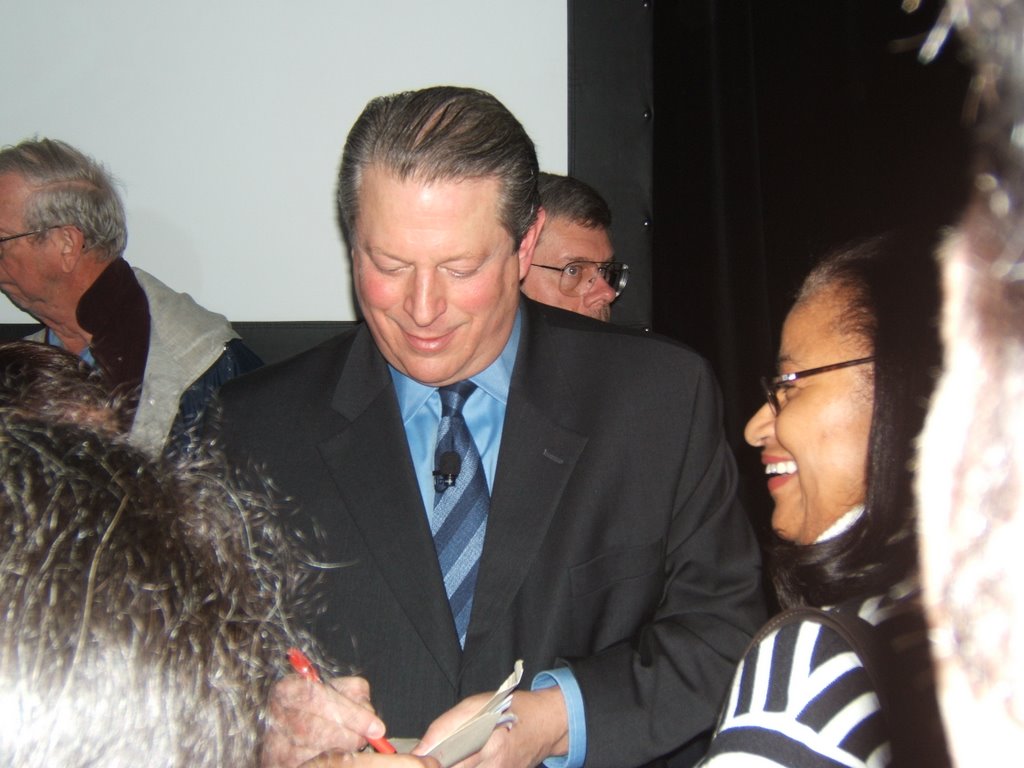
We need to do something.
But what, Al?
I'm going to start by encouraging you to find out more. And don't stop there.
Filed under
the environment
because I didn't vote in the last federal election. No, not last Tuesday. Sadly, I wasn't allowed to vote in that one. (Kudos to the people who did, though.) I meant that I didn't vote in the last Canadian federal election. It was pure laziness, really, and maybe a lack of appropriate stamps. I'm usually very intent on voting, but the whole get-all-your-papers-together, send-in-this-form, receive-the-ballot-in-the-mail, send-back-the-ballot, and do this all by, say, last week kind of took me by surprise and it just didn't end up happening.
Aside: I also fully screwed up our Canadian taxes, and the Government of Canada is giving us WAY too much money right now. No worries, though. I'm on it. I just admit this to show that it's not exactly straight-forward to navigate this "living in another country" thing. It's often a bit of a pain.
But I do take full responsibility for not voting, and hence, our current predicament. It's hard to stay on top of things from afar, but thanks to the interweb (sigh... I miss Corner Gas), I can find out goodies like this on TheStar.com:
----
---
{blink blink} Wow. Good for us. We beat the U.S. for being only SLIGHTLY less concerned about climate change than Kazakhstan. Kazakhstan. Really? For Pete's sake, Iran is doing better than we are. What kind of legacy is this?
Filed under
the environment
"Whatever that meant, well, I just couldn't guess
... But now, says the Once-ler,
Now that you're here, the word of the Lorax seems perfectly clear.
UNLESS someone like you cares a whole awful lot,
nothing is going to get better. It's not." - Dr. Seuss, The Lorax
I just read this article. I'm not surprised, and I don't think it'll be the last time we'll read something like this. The part about the positive feedback loop - it's scary, but REAL.
Filed under
the environment
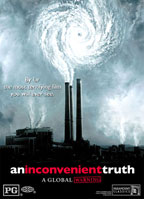 On Monday evening I went to see An Inconvenient Truth, Al Gore's documentary on Global Warming/Climate Change. Have you heard of it? I hadn't until last week, at least not in the active or conscious part of my brain.
For those of you in Canada, you may be unaware of the movie in part because it isn't getting much press according to a commentary I read in The Toronto Star. It is definitely directed towards a U.S. audience, which makes sense considering the source. I checked, however, and it is being shown in Canada, at least in the GTA.
As a scientist, and an atmospheric scientist no less, I felt I had a responsibility to see the movie to determine whether or not I should recommend that others see it as well. (Specifically those who don't call themselves scientists) The verdict is pretty simple, though not entirely predictable. The quick answer is YES. You should go.
The longer, more involved answer:
For those of you who don’t know, which included myself until last night, Gore has been a student of global warming for about 20 years now. (Note: the more scientifically-acceptable term is actually climate change as not all locations are predicted to experience increases in temperature. According to models, some places may become significantly cooler.)
See the movie. Or if you prefer, read the book. Get informed. Your great-grandchildren will thank you for it.
Filed under
the environment
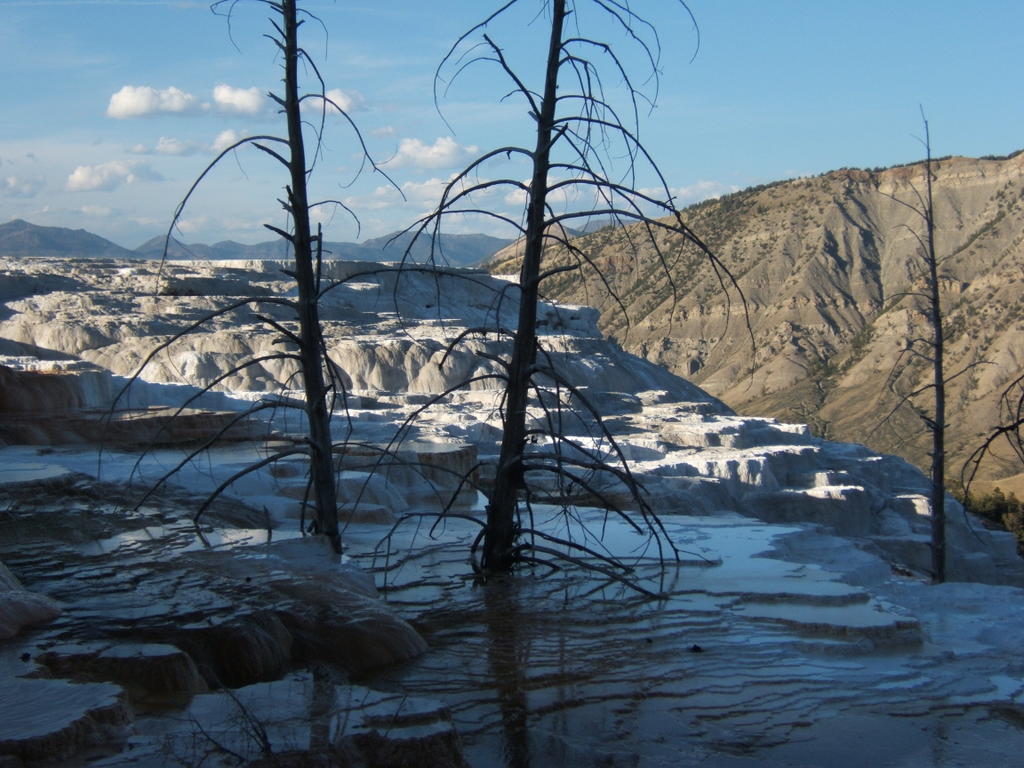 I'm home... Perhaps some of you didn't know I was gone? Well then - let me fill you in:
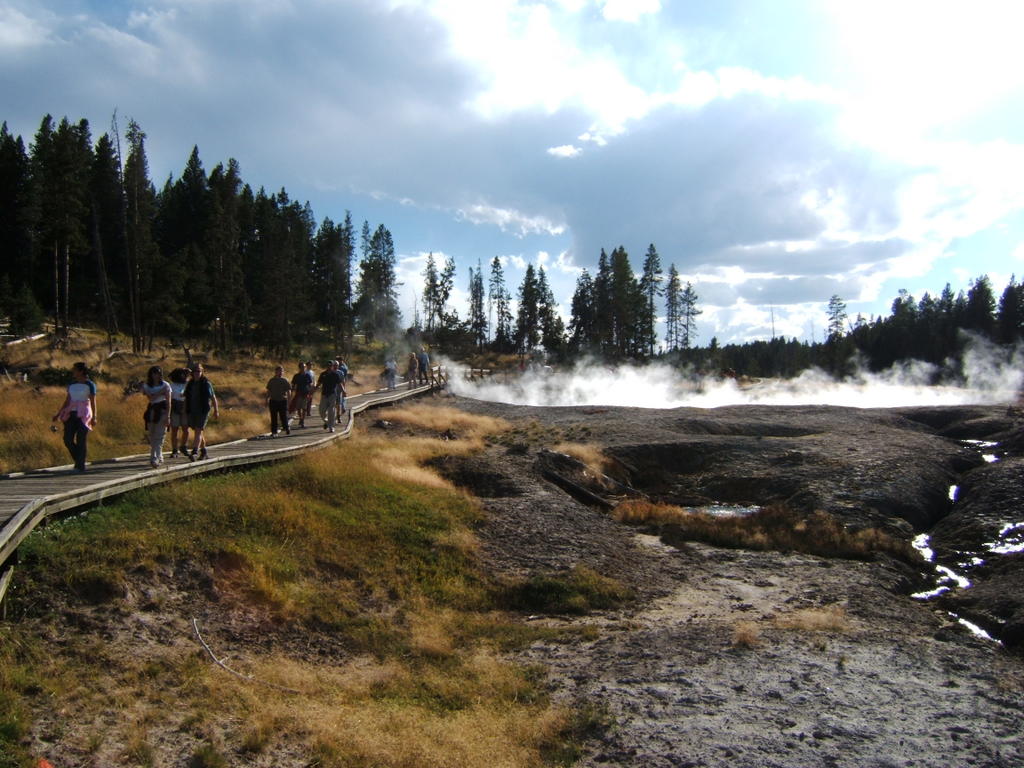
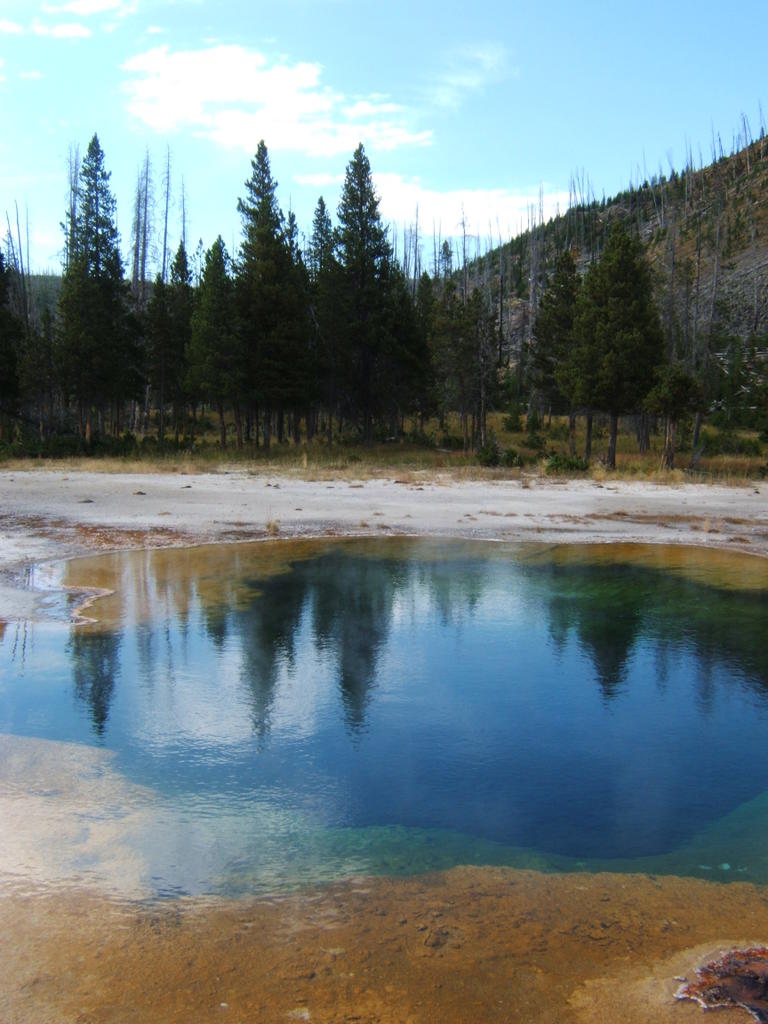 I've never been to either Montana or Wyoming, and I was absolutely in awe... Yellowstone is beautiful (all three photos shown here are from Yellowstone Park), and has an incredible number of stunning and amazing sights and wildlife. I really can't do them justice to describe them, but if you're interested, you can check out the rest of my pictures on the Shoppers site (along with some lengthy descriptions.) A warning - there are a LOT of pictures... my apologies to those of you with slow internet access.
 It occurred to me today while I was reading my friend Rhian's blog that many of you probably don't really know what it is that I and other atmospheric chemists actually do with our time. She explains it much more eloquently than I can, but essentially, we study the gas-phase and aerosol (gas-liquid and gas-solid) chemistry that occurs in the complex mixture of the atmosphere.
Filed under
science,
the environment
www.flickr.com
|
 ə
ə
